
CLIFF: The CLIMATE FIREFIGHTER INITIATIVE
This contribution* presents the network idea of a voluntary international climate protection fire brigade, in which initiatives, researchers, and foundations, among others, work together. It describes the overarching framework for evidence-based action towards climate neutrality, providing clarity and tools for effective climate action!
Despite global commitments, we are not on track to meet the Paris Agreement goals. The built environment – construction, operation, and demolition of buildings – remains a major, yet under-addressed, source of greenhouse gas emissions. Key barriers are fragmented, unreliable information that hinder unified, effective climate action.
CLIFF offers a unique framework to extinguish the “fires” blocking climate progress with cost-effective
measures. CLIFF enables a sustainably climate-neutral world based on facts and unbiased information that reflect reality as it is. It brings assembled and structured insights from current science to practice and fills knowledge gaps effectively and scientifically unbiased.
CLIFF evolved from a spontaneous discussion at ISEC 2024. The concept was further developed ever since. For taking off, the initiative is now reaching out to motivate involvement and gather the power and expertise from experts all over the world.
VISION AND MISSION
CLIFF supports the well-being of all beings on planet Earth by enabling concerted, sustainable action to stabilize the climate. A stable climate is not an end in itself, but a precondition for thriving societies, resilient ecosystems, and a just future. CLIFF bridges the gap between science and real-world solutions by providing unbiased, actionable insights, and by fostering a coherent framework that integrates climate stability with all other relevant dimensions of sustainability.
As a first step, the CLIFF Initiative focuses on the built environment—one of the largest sources of greenhouse gas emissions. From construction and operation to demolition and disposal, buildings and infrastructure account for a significant share of climate impacts. By addressing these challenges comprehensively, CLIFF aims to transform the built environment into a driver of climate resilience and sustainable development.
SOLUTION
CLIFF follows a unique approach. The umbrella structure unites fragmented efforts and thereby ensures that no critical knowledge is overlooked. Furthermore, by at first focusing on one sector – the built environment – one of the most significant and cost-effective levers for emission reduction is targeted.
The CLIFF framework to extinguish the “fires” blocking climate progress includes:
- Integration: CLIFF maps the full landscape of climate knowledge, identifying gaps (“missing puzzle pieces”) critical to achieving climate targets.
- Research: CLIFF commissions targeted studies to fill these gaps with reliable, actionable data.
- Guidance: CLIFF translates findings into practical guidance.
The first step to realizing the vision of an evidence based sustainable world is to identify the gaps between current knowledge and practices. And especially those required to reach the goals of the Paris Agreement. An analogy is that reaching climate targets is a puzzle. CLIFF identifies puzzle pieces, where they fit and what is missing. The missing parts are then researched.
In a second step, research is proposed to fill the gaps with reliable and comprehensive information.
A third step entails conducting the required research and integrating its findings into a continuously improving and updated guidance system for decision- and policymakers and industry leaders.
Like any firefighter initiative, the idea is to keep the CLIFF initiative ongoing until the fire is extinguished, which means the target of climate sustainability is reached.
STATUS QUO
The initiative’s early status will be presented, including preliminary work on open digital methods and on
networking to overcome disinformation through clear and neutral CLIFF guidance.
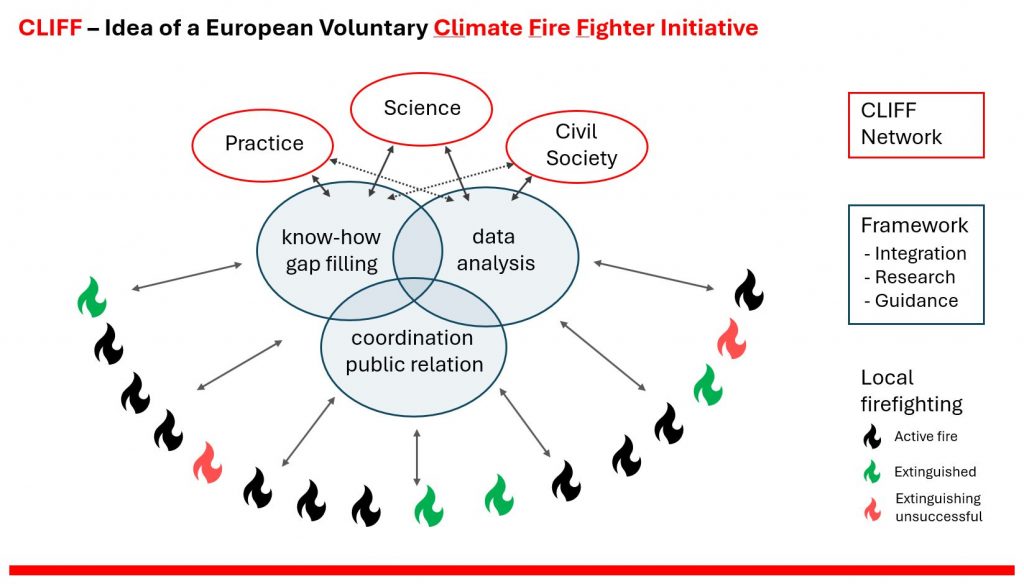
At the CLIFF kick-off meeting examples will be given of how independent and open data can support science, industry, and decision-makers from civil society and politics. The status of organizational preparations for specific “firefighting operations,” e.g., with foundations, will be explained.
CALL TO ACTION
The successful implementation of the CLIFF Initiative requires a combination of interdisciplinary cooperation and research, promotion of best practices, education, training, and advocacy. Experts from diverse disciplines are invited to join the initiative, bring in their expertise, and develop CLIFF as an umbrella structure as well as collaborate in research projects to fill the identified gaps.
Support the CLIFF Initiative as an overarching framework for evidence-based action towards sustainable climate neutrality, providing clarity and tools for effective climate action. Thereby, you empower decision-makers with the clarity and tools they need for effective climate action that is the foundation of a sustainable and just future for them, their children and everyone else on planet Earth.
ABOUT
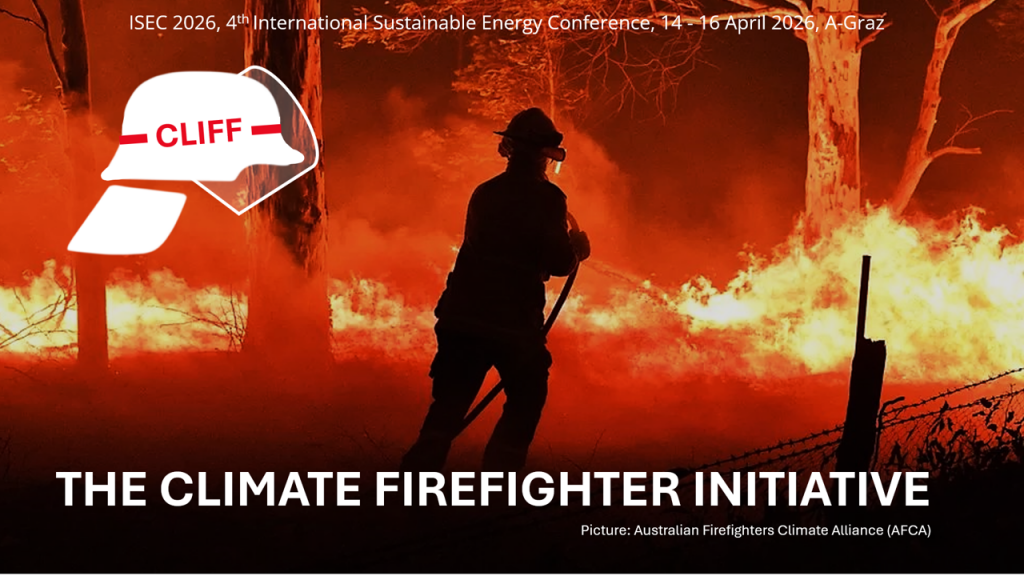
* This website contains the text of the abstract for the CLIFF poster for ISEC 2026. We thank the Australian Firefighters Climate Alliance (AFCA) for their friendly allowance to use their images.
The text is a joint statement by Jörg Ortjohann1, Dr. Andrej Jentsch2, Tomislav Novosel3, Prof. Dr. Urban Persson4, Dr. Teodora-Emilia Motoasca5, Benjamin Köhler6, Dr. Tobias Weiss7 and Christoph Moser7.
1 – Contact adress: Stiftung Energieeffizienz, Weyerstr. 32, 50676 Köln, Germany: Phone +49 221 54657-05, E-Mail: j.ortjohann@stiftung-energieeffizienz.org
2 – AGFW | Der Energieeffizienzverband für Wärme, Kälte und KWK e. V., Stresemannallee 30, 60596 Frankfurt, Germany
3 – Stichting The Institute for European Energy and Climate Policy (IEECP), Amsterdam Sloterdijk Teleport Towers Kingsfordweg 151, Amsterdam, 1043GR, Netherlands
4 – Halmstad University, Kristian IV:s väg 3, 301 18 Halmstad, Sweden
5 – Energy expert, 9090 Merelbeke-Melle, Belgium
6 – Öko-Institut, Merzhauser Straße 173, 79117 Freiburg, Germany
7 – AEE – Institut für Nachhaltige Technologien, Feldgasse 19, 8200 Gleisdorf, Austria